


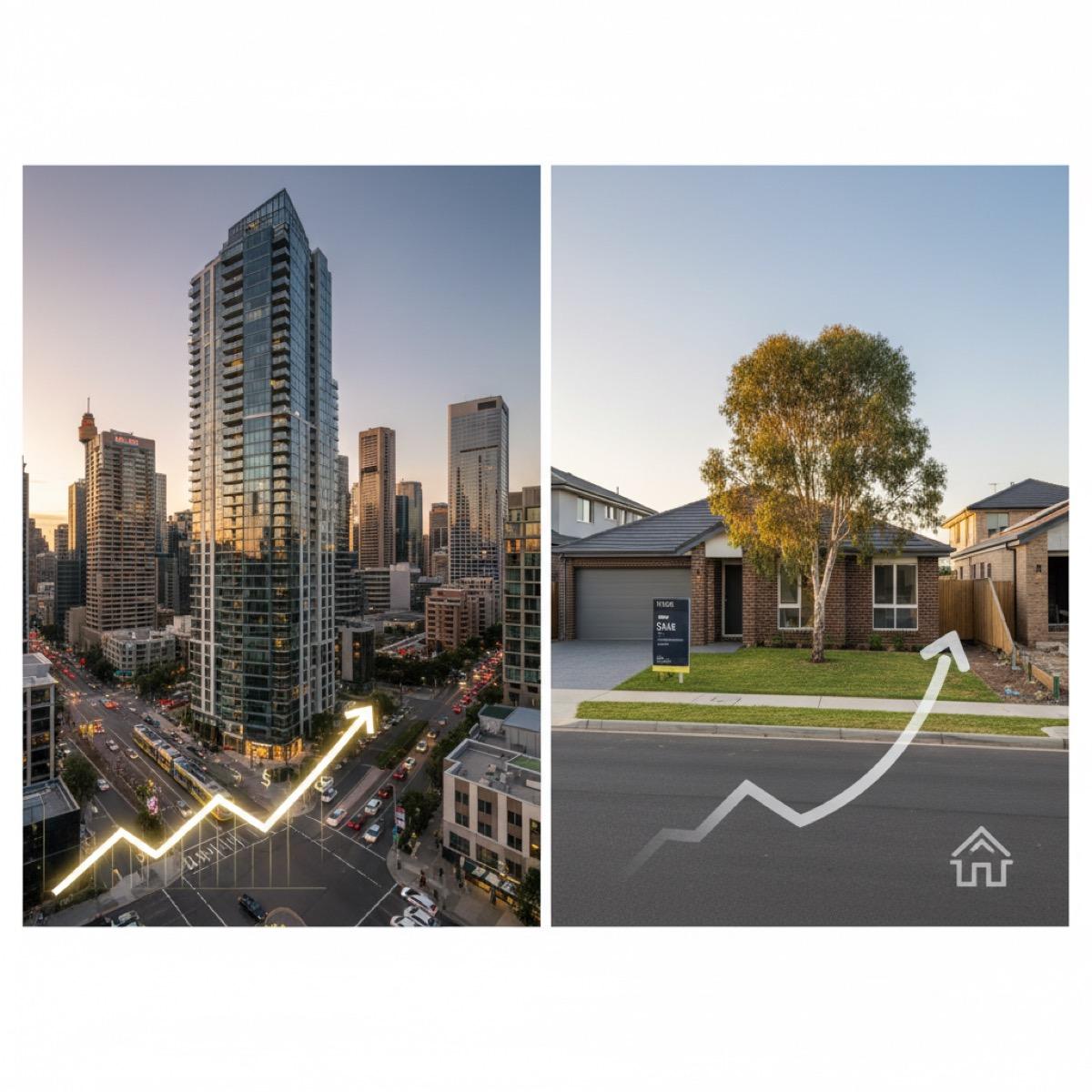
Capital Growth vs Cash Flow: Which Property Strategy Fits Your Situation in 2026?
📊 TL;DR - Key Takeaways
- Capital growth = property value increases over time (wealth building)
- Cash flow = rental income minus expenses (weekly income)
- Most investors need both — but at different life stages, one matters more
- High cash flow properties often have lower growth (and vice versa)
- Your strategy depends on: income needs, tax position, timeline, and risk tolerance
Capital Growth vs Cash Flow: The Core Trade-Off
The capital growth vs cash flow debate is one of the most fundamental decisions in property investing. It shapes:
- Where you buy
- What you buy
- How long you hold
- Your overall investment strategy
Let's break down both strategies, compare them side-by-side, and help you figure out which fits your situation in 2026.
What Is Capital Growth?
Capital growth (or capital appreciation) is the increase in your property's value over time. If you buy a house for $600,000 and it's worth $750,000 five years later, you've achieved $150,000 in capital growth.
How you profit:
- Sell the property and pocket the gain (less CGT)
- Refinance to access equity without selling
- Use equity to fund further investments
Capital Growth Strategy in Action
Example: Buying in inner-city Melbourne
- Purchase price: $900,000 (3-bed house, Brunswick)
- Rental income: $650/week ($33,800/year)
- Gross yield: 3.8%
- Annual growth (5-year avg): 6.2%
- Value after 5 years: $1,212,000
- Capital gain: $312,000 (tax-free if PPOR, or 50% discount if held 12+ months)
Cash flow reality: This property is negatively geared — you're contributing $8,000-12,000/year out of pocket to hold it. But the long-term wealth created via capital growth far outweighs the short-term holding costs.
What Is Cash Flow?
Cash flow is the net income you receive from a property after all expenses are paid. Positive cash flow means the property pays for itself (and ideally, puts money in your pocket each week).
How you profit:
- Weekly/monthly rental income exceeds all costs
- Build a passive income stream
- Reinvest surplus income into more properties
Cash Flow Strategy in Action
Example: Buying in regional markets Queensland
- Purchase price: $420,000 (3-bed house, Gladstone)
- Rental income: $480/week ($24,960/year)
- Gross yield: 5.9%
- Annual growth (5-year avg): 2.1%
- Value after 5 years: $465,000
- Capital gain: $45,000
Cash flow reality: After expenses (rates, insurance, maintenance, PM fees), this property delivers $150-200/week positive cash flow. Over 5 years, that's $39,000-52,000 in income — plus the $45K capital gain.
Total return: $84,000-97,000 over 5 years.
Side-by-Side Comparison
Factor Capital Growth Strategy Cash Flow Strategy Primary goal Build long-term wealth Generate passive income Typical yield 2.5-4.5% (low) 5.0-7.5% (high) Typical growth 5-8% p.a. 1-3% p.a. Cash flow Negative (you pay) Positive (property pays you) Location Capital cities, inner suburbs Regional towns, outer suburbs Property type Houses, townhouses Units, dual-income properties Risk Market volatility, holding costs Tenant dependency, lower growth Best for High income earners, long timeline Retirees, income-focused investors Tax benefits Negative gearing deductions Lower deductions (less loss) Equity access High (refinance gains) Low (slower equity build) The Hidden Trade-Off: You Rarely Get Both
Properties that deliver high rental yields typically have lower capital growth — and vice versa. This is known as the yield-growth trade-off.
Why?
- High-growth areas (inner cities, trendy suburbs) attract owner-occupiers who compete aggressively, pushing purchase prices up relative to rents.
- High-yield areas (regional towns, mining areas) have weaker owner-occupier demand, keeping prices low but rents relatively high due to investor and short-term worker demand.
The Yield-Growth Spectrum (March 2026)
Location Gross Yield 5-Year Growth (p.a.) Strategy Type Sydney Inner West 3.1% 7.8% Growth Melbourne CBD 4.2% 3.4% Balanced Brisbane Northside 4.0% 8.1% Growth Adelaide Hills 4.8% 6.2% Balanced Perth Northern Suburbs 5.1% 5.9% Balanced Hobart Suburbs 5.4% 2.7% Cash Flow Regional NSW (Bathurst) 6.2% 1.9% Cash Flow Regional QLD (Mackay) 6.8% 0.8% Cash Flow Source: CoreLogic, PropTrack, Domain Rental Reports (Q1 2026)
Key Insight: Properties with yields above 6% almost always have annual growth below 3%. Properties with growth above 7% almost always yield below 4%.
Which Strategy Fits Your Situation?
Choose Capital Growth If You:
- Have a stable, high income (can afford to subsidise holding costs)
- Have a long investment timeline (10+ years to ride out market cycles)
- Want to build wealth for retirement
- Can benefit from negative gearing (tax deductions offset holding costs)
- Plan to use equity for future investments (leverage strategy)
- Are comfortable with market volatility
Life stage: Typically best for investors aged 30-50 with strong income and 10-20 year horizon.
Choose Cash Flow If You:
- Need passive income now (or soon)
- Are approaching or in retirement
- Have limited ability to service debt (self-employed, variable income)
- Want properties that "pay for themselves"
- Are risk-averse (prefer income certainty over growth speculation)
- Want to scale quickly (positive cash flow lets you borrow more)
Life stage: Typically best for investors aged 50+ or those building passive income streams.
The Hybrid Approach: Why Not Both?
Many experienced investors use a blended portfolio strategy:
- 60-70% capital growth properties (inner city houses, strong fundamentals)
- 30-40% cash flow properties (regional high-yield, to cover some holding costs)
Benefits:
- Growth properties build long-term wealth
- Cash flow properties reduce out-of-pocket costs
- Diversification across markets and property types
- Flexibility to shift strategy as life stage changes
Example Portfolio (March 2026):
Property Location Value Yield Strategy Cash Flow House Brisbane Northside $820K 4.1% Growth -$180/week House Adelaide Inner $710K 4.6% Balanced -$40/week Unit Regional NSW $385K 6.4% Cash Flow +$150/week Net position: Total portfolio value $1.915M, net cash flow -$70/week (manageable), strong growth potential on 76% of portfolio value.
Real-World Scenario Analysis (2026)
Scenario 1: The High Earner (Age 38, $180K income)
Situation:
- Stable PAYG income, can afford $15,000/year in negative cash flow
- 20-year investment horizon
- Tax rate: 39% (marginal)
Recommended strategy: Capital growth focused
- Buy in established inner suburbs (Brisbane, Adelaide, Perth growth corridors)
- Accept 3.5-4.5% yield
- Target 6-8% annual growth
- Negative gearing reduces taxable income by $5,850/year (39% of $15K loss)
10-year outcome:
- Purchase price: $800,000
- Value after 10 years: $1.435M (6% p.a. growth)
- Capital gain: $635,000
- Total cash outlay: $150,000 (less $58,500 tax savings = $91,500 net)
- Net profit: $543,500 (even after 10 years of negative cash flow)
Scenario 2: The Retiree (Age 62, $70K income)
Situation:
- Fixed income (super + part-time work)
- Cannot afford ongoing negative cash flow
- Wants income security
Recommended strategy: Cash flow focused
- Buy in high-yield regional areas (Ballarat, Toowoomba, Bunbury)
- Target 5.5-6.5% yield
- Accept modest growth (2-3% p.a.)
- Property should generate $150-250/week positive cash flow
10-year outcome:
- Purchase price: $450,000
- Value after 10 years: $560,000 (2.2% p.a. growth)
- Capital gain: $110,000
- Cash flow income: $130,000 over 10 years ($250/week average)
- Total return: $240,000 (with zero out-of-pocket cost)
Tax Implications: How Each Strategy Is Taxed
Capital Growth Strategy
During ownership:
- Negative gearing losses reduce your taxable income
- Depreciation deductions further reduce tax
- Rental income is taxed as ordinary income
On sale:
- Capital gains are taxed (but 50% discount if held 12+ months)
- Example: $300K gain → $150K taxable (at your marginal rate)
Cash Flow Strategy
During ownership:
- Positive cash flow is taxable income
- Fewer deductions (no negative gearing benefit)
- Still claim depreciation and expenses
On sale:
- Same CGT rules apply (50% discount if 12+ months)
- But lower capital gains means lower tax liability
Tax Tip: High income earners benefit more from negative gearing (larger tax deductions). Lower income earners benefit more from positive cash flow (lower tax rate on rental income).
Common Mistakes to Avoid
Mistake 1: Chasing Yield Without Checking Growth
A 7% yield sounds great — until you realise the suburb has declining population and zero growth for 10 years. You're just getting your capital back as income.
Solution: Check 5-year price history and population trends. Avoid areas with structural decline.
Mistake 2: Buying Growth Without Affordable Cash Flow
Buying a $1.2M Sydney property with 3% yield while earning $90K/year leaves you stretched. One job loss or rate hike and you're forced to sell at the worst time.
Solution: Stress-test your finances. Can you afford an extra 2% on the interest rate? 6 months vacancy?
Mistake 3: Not Adjusting Strategy Over Time
A 35-year-old buying growth properties makes sense. A 60-year-old doing the same (with 10 years to retirement) is taking unnecessary risk.
Solution: Review your strategy every 5 years. Shift from growth to income as you approach retirement.
What This Means for You (March 2026)
The Australian property market in 2026 presents opportunities in both strategies:
Capital Growth hotspots:
- Adelaide (affordability + infrastructure boom)
- Perth northern suburbs (mining sector recovery)
- Brisbane inner west (Olympics 2032 effect)
- Regional cities with population growth (Ballarat, Geelong, Toowoomba)
Cash Flow opportunities:
- Regional QLD (Gladstone, Mackay, Emerald)
- Regional NSW (Dubbo, Bathurst, Orange)
- Outer suburban units in capital cities (with 10km employment hubs)
Current market context:
- RBA cash rate: 4.35% (holding since November 2025)
- Rental vacancy rates: Tight (under 2% in most capitals) = high yields
- First home buyer activity: Recovering = demand boost for affordable segments
Frequently Asked Questions
Q: Which is better for property investment — capital growth or cashflow?
A: Neither is inherently better. Growth strategies build long-term wealth through property appreciation, while cashflow strategies generate immediate income. The right choice depends on your income, time horizon, risk tolerance, and financial goals. Many successful investors combine both.
Q: Can a property deliver both capital growth and positive cashflow?
A: Yes, though it's less common. Properties in growing regional centres with strong rental demand — like some North Queensland markets — can deliver both 5%+ yields and meaningful capital growth. Look for suburbs with rising owner-occupier ratios (growth signal) AND low vacancy (cashflow signal).
Q: How do interest rates affect the growth vs cashflow decision?
A: Higher interest rates make cashflow more important because holding costs increase. In a high-rate environment, positively geared properties are less risky. In low-rate environments, growth strategies are easier to sustain because the holding cost of negatively geared properties is lower.
Key Takeaways
- Capital growth builds long-term wealth; cash flow generates passive income
- High-yield properties almost always have lower growth (and vice versa)
- Choose based on: income level, life stage, timeline, and risk tolerance
- High earners benefit from negative gearing (capital growth strategy)
- Retirees and income-focused investors should prioritise cash flow
- A blended portfolio (60/40 growth/yield) offers balance and flexibility
- Adjust your strategy as you age — shift from growth to income over time
Picki helps you identify both growth and cash flow opportunities with suburb-level yield data, capital growth forecasts, vacancy rates, and R-Score rankings. Filter by strategy type and find properties that match your investment goals. Start your free trial.
Sources: CoreLogic Home Value Index (March 2026), Domain Rental Report (Q1 2026), PropTrack Investment Analysis, ABS Census Data 2021, ATO Taxation Statistics 2024-25